Children's Eye Care

Clear vision supports how a child explores, learns and grows.

Age-appropriate eye examinations for babies, children and teenagers—covering glasses, amblyopia, squint, myopia progression, cataract and other conditions that may be difficult for a child to describe.

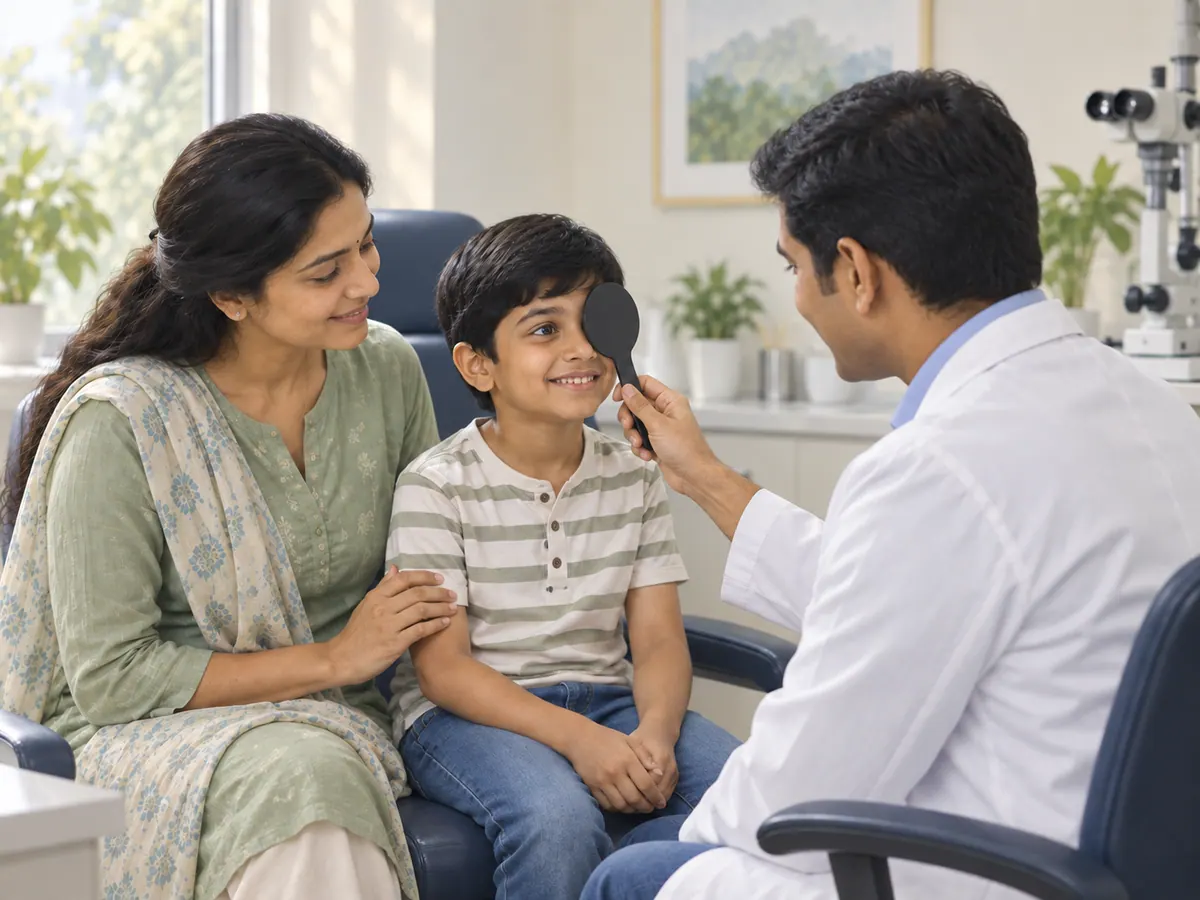
Illustration of a child having an eye check with a parent present
Child-friendly Age-appropriate testing
Why early diagnosis matters

Children often adapt to blur instead of reporting it.

A child with one weaker eye may function normally using the stronger eye. A child who has always seen the board unclearly may assume everyone sees the same way. Screening and examination are therefore designed to find problems before a complaint appears.

During childhood, the brain is learning how to use the image from each eye. Persistent blur, cataract or misalignment can interrupt this development and cause amblyopia. Treatment is generally more effective when started early, but age is not an automatic reason to withhold an assessment or treatment.

Seek prompt assessment

Some childhood eye signs should not wait for routine screening.

A young child may not explain pain or vision loss clearly. A change in the pupil, eye position, behaviour or appearance can therefore be clinically important even when the child does not complain.

  • A white or grey pupil, abnormal flash-photo reflex or new cloudiness
  • Sudden vision loss, new double vision or a newly developed constant squint
  • Eye injury, chemical exposure or a sharp object near the eye
  • Severe pain, marked light sensitivity or a very red eye
  • A painful red swelling near the inner corner of the eye with fever
  • A premature baby missing a scheduled ROP examination
Children's eye conditions

The same behaviour can come from very different visual problems.

Squinting, sitting close or avoiding reading does not establish a diagnosis. Testing each eye separately and examining focusing, alignment and eye health helps distinguish refractive blur, amblyopia, eye disease and non-visual causes.

01Myopia, hyperopia and astigmatism

Refractive errors

A child may not know that the board, books or one eye looks blurred. Unequal prescriptions can be especially difficult to notice because the stronger eye compensates.

How care may be planned

Age-appropriate vision testing and cycloplegic refraction help determine whether glasses are needed. Prescriptions are reviewed as the eyes grow, with closer follow-up when vision differs between the eyes.

02Reduced visual development

Amblyopia

Amblyopia develops when the brain receives a consistently blurred or conflicting image from one or both eyes during childhood. The eye may look completely normal, and children rarely identify the weaker eye themselves.

How care may be planned

Treatment begins with the cause—often glasses, alignment care or cataract management—then may include prescribed patching or atropine in the better-seeing eye. Earlier treatment is generally more effective, but older children may still benefit after assessment.

03Eyes that do not align together

Strabismus (squint)

One eye may turn inward, outward, upward or downward constantly or intermittently. Squint can affect binocular vision, depth perception and visual development, although not every apparent eye turn is true strabismus.

How care may be planned

The plan depends on age, vision, refractive error and the type and frequency of the deviation. Glasses, amblyopia treatment, prisms or eye-muscle surgery may be considered for selected children.

04Clouding of a developing eye’s lens

Childhood cataract

A cataract present at birth or developing in childhood can block a clear image from reaching the retina. Dense central cataracts can rapidly interfere with visual development, while small peripheral cataracts may only need monitoring.

How care may be planned

Visually significant cataracts require prompt specialist planning. Surgery may be followed by an intraocular lens, contact lens or glasses plus sustained amblyopia treatment and long-term monitoring.

05Increasing short-sightedness

Progressive childhood myopia

Myopia makes distant objects blurred and often increases while the eye is growing. Higher myopia is associated with greater lifetime risk of retinal and other eye complications.

How care may be planned

Accurate glasses remain essential. Outdoor time and, for suitable children, evidence-based myopia-control options such as specialised lenses or low-dose atropine can be discussed with benefits, limitations and follow-up requirements.

06Persistent watering or discharge in infancy

Blocked tear duct

A congenital nasolacrimal duct obstruction prevents tears draining normally and can cause overflow, crusting or discharge. Most resolve during the first year, but persistent watering also needs assessment for less common causes.

How care may be planned

Parents may be taught the correct massage technique. Antibiotic drops treat significant discharge rather than opening the duct. Persistent or severe obstruction may require probing or another drainage procedure.

07ROP screening for premature infants

Retinopathy of prematurity

ROP affects developing retinal blood vessels in babies born very prematurely or at very low birth weight. Early stages are invisible to parents, so screening must follow the neonatal team’s timetable.

How care may be planned

Many babies require observation only; higher-risk disease may need laser, anti-VEGF treatment or surgery through an appropriately trained retina team. Follow-up dates must be kept precisely.

08Difficulty distinguishing certain colours

Colour vision deficiency

Inherited red–green colour vision deficiency is more common in boys and may only become apparent during school tasks. It does not usually reduce sharpness of vision.

How care may be planned

Testing can document the pattern and support practical classroom and career counselling. No spectacle or exercise restores inherited colour discrimination, but clear labelling and alternative cues can help.

09Droopy lid, white pupil or unusual eye appearance

Ptosis and other visible eye differences

A droopy lid can block vision or induce astigmatism. A white pupil, abnormal red reflex, enlarged eye or persistent asymmetry may signal a condition requiring urgent investigation.

How care may be planned

Examination determines whether the difference threatens sight, indicates another eye disorder or is primarily cosmetic. Timing of treatment is based on visual development and the underlying cause.

Clues worth noticing

Look for patterns at home and at school.

Signs at home

  • Closing or covering one eye, or turning the head to see
  • Sitting unusually close to screens or holding material very near
  • Frequent squinting, blinking, eye rubbing or headaches
  • An eye that drifts in, out, up or down—even intermittently
  • Persistent watering, discharge, light sensitivity or redness
  • Difficulty reaching for objects or judging steps and distances

Signs during learning

  • Difficulty seeing the board or copying from a distance
  • Losing place, skipping lines or tiring during visual work
  • Avoiding reading, drawing or other near tasks
  • Headaches or eye strain after schoolwork
  • A sudden decline in classroom participation or visually demanding work
  • A teacher noticing one eye closing, head tilting or unusually close working distance

These behaviours can have many causes and some children with serious eye problems show none of them. A failed screen, teacher concern or persistent pattern deserves a proper eye assessment rather than self-diagnosis.

A child's eye examination

Testing adapts to the child—not the other way around.

Children do not need to know letters or sit perfectly still for every part of the visit. The examination uses observation, matching, lights, pictures and objective measurements according to age and developmental ability.

01

Age-appropriate vision

Babies can be assessed by fixation and eye preference; toddlers can match symbols; older children can use letter or number charts. Each eye is tested separately whenever possible.

02

Alignment and eye movements

Cover tests, corneal light reflexes and movement assessment look for squint, reduced binocular function or a movement pattern needing further investigation.

03

Pupils, red reflex and eye health

The lids, front of the eyes, pupils and red reflex are checked for structural differences, cataract, inflammation and other visible disease.

04

Cycloplegic refraction

Dilating drops temporarily relax a child’s strong focusing system so the full glasses prescription can be measured accurately. Near blur and light sensitivity can last several hours.

05

Dilated internal examination

When indicated, dilation allows examination of the lens, optic nerve, macula and retina and helps explain reduced vision that is not due to refractive error alone.

Screening timeline

Eye checks begin at birth and change as a child develops.

Screening identifies children who need a complete examination; it does not replace one. Children with symptoms, developmental risk, premature birth, a failed screen or family history may require assessment outside the routine timeline.

Newborn01

Before leaving newborn care

External eye inspection, pupil response and red-reflex assessment can identify cataract and other structural abnormalities needing urgent referral.

Infancy02

During routine child-health visits

Tracking, alignment, pupils, red reflex and the appearance of the eyes are reviewed. Poor tracking after early infancy, persistent crossing, tearing or an abnormal reflex warrants assessment.

1–3 years03

Instrument-based screening when available

Photoscreening can identify amblyopia risk factors before a child can reliably name chart symbols. A “refer” result requires a complete eye examination.

3–5 years04

Formal vision screening at least once

Each eye should be checked separately with an age-appropriate chart or validated screening method so amblyopia and unequal vision are not missed.

5+ years05

Repeat screening through school years

Screening every one to two years is commonly recommended. Children who fail, develop symptoms or have significant risk need a comprehensive examination rather than screening alone.

On treatment06

Follow the individual clinical schedule

Glasses, amblyopia, squint, myopia control and eye disease usually need more specific review intervals. Attend sooner if vision, alignment or symptoms change.

Progressive myopia

Clear glasses solve today’s blur; myopia control aims to slow future change.

Myopia often increases while a child is growing. Regular refraction tracks the prescription, while axial-length measurement may be useful when available. More outdoor time is associated with a lower risk of developing myopia and is a healthy habit, but it does not replace prescribed correction.

Specialised spectacle or contact lenses and low-dose atropine may slow progression in selected children. Choice depends on age, rate of change, prescription, eye health, adherence, cost and local availability. Contact lenses require careful hygiene because infection can threaten vision.

A sensible review includes
  • Current and previous spectacle prescriptions
  • Family history of myopia
  • Outdoor time and near-work habits
  • Rate of prescription or eye-length change
  • Benefits, limitations and follow-up for each option
Arrange a myopia review
Insurance and cashless guidance

Children's outpatient care, spectacles and procedures may have different benefits.

Policies often treat consultation, refraction, glasses, contact lenses, scans and surgery separately. A medically necessary procedure may require pre-authorisation and supporting examination records even when routine spectacles are excluded.

JEWCC can help prepare available clinical documents, but coverage, co-payment and reimbursement remain subject to the insurer or TPA.

JEWCC eye centres

Arrange a child-friendly eye examination near you.

When booking, mention the child’s age, symptoms, failed screening result and any developmental or premature-birth history. Bring current glasses, earlier prescriptions, school-screening reports and relevant medical records.

Children's eye-care FAQs

Practical answers for parents and caregivers.

01Can a young child have an eye test without knowing letters?

Yes. Babies are assessed through fixation, tracking, eye preference and examination findings. Toddlers can match pictures or symbols, and objective instruments can identify certain amblyopia risk factors. A child does not need to read an alphabet chart for an eye problem to be detected.

02Does amblyopia treatment stop working after age eight?

No single birthday creates an absolute cut-off. Visual development is most adaptable in early childhood and prompt treatment usually offers the best opportunity, but studies show that some older children can still improve. Treatment should be based on the child’s findings rather than abandoned because of age alone.

03Can glasses improve my child’s school performance?

If uncorrected blur or unequal vision was making it difficult to see the board, read comfortably or sustain visual work, appropriate glasses and treatment may improve access to classroom information. They do not treat dyslexia, attention disorders or every cause of academic difficulty, so persistent concerns need educational and medical evaluation as appropriate.

04Will wearing glasses make a child’s eyes weaker?

No. Correctly prescribed glasses provide a focused image while the eyes and visual brain are developing. Some prescriptions change naturally as the child grows, but that is not caused by wearing glasses. Significant blur left uncorrected can contribute to amblyopia.

05Does every childhood squint need surgery?

No. Treatment depends on the squint type, glasses prescription, visual development and frequency. Some children improve with glasses or amblyopia treatment, while others need eye-muscle surgery for alignment. Surgery may align the eyes but does not replace prescribed glasses or amblyopia care.

06How often should a child’s eyes be examined?

Routine age-appropriate screening should occur repeatedly through childhood. AAPOS recommends repeat screening every one to two years after age five. A comprehensive examination is needed after a failed screen, when symptoms or risk factors are present, or according to the clinician’s schedule for glasses or an established condition.

07Are children’s eye tests, glasses or surgery covered by insurance?

Coverage varies. Outpatient examination, refraction and spectacles may be excluded even when medically necessary surgery is eligible. Procedures commonly require diagnosis documents and pre-authorisation. JEWCC can help provide available clinical records, while the insurer or TPA makes the final decision.