Specialist consultation
Consultations with a squint specialist are available by prior appointment. Contact us to confirm the centre and timing.
Consultant squint surgeon appointments for children and adults, supported by detailed alignment measurements, amblyopia care and squint surgery available through JEWCC.
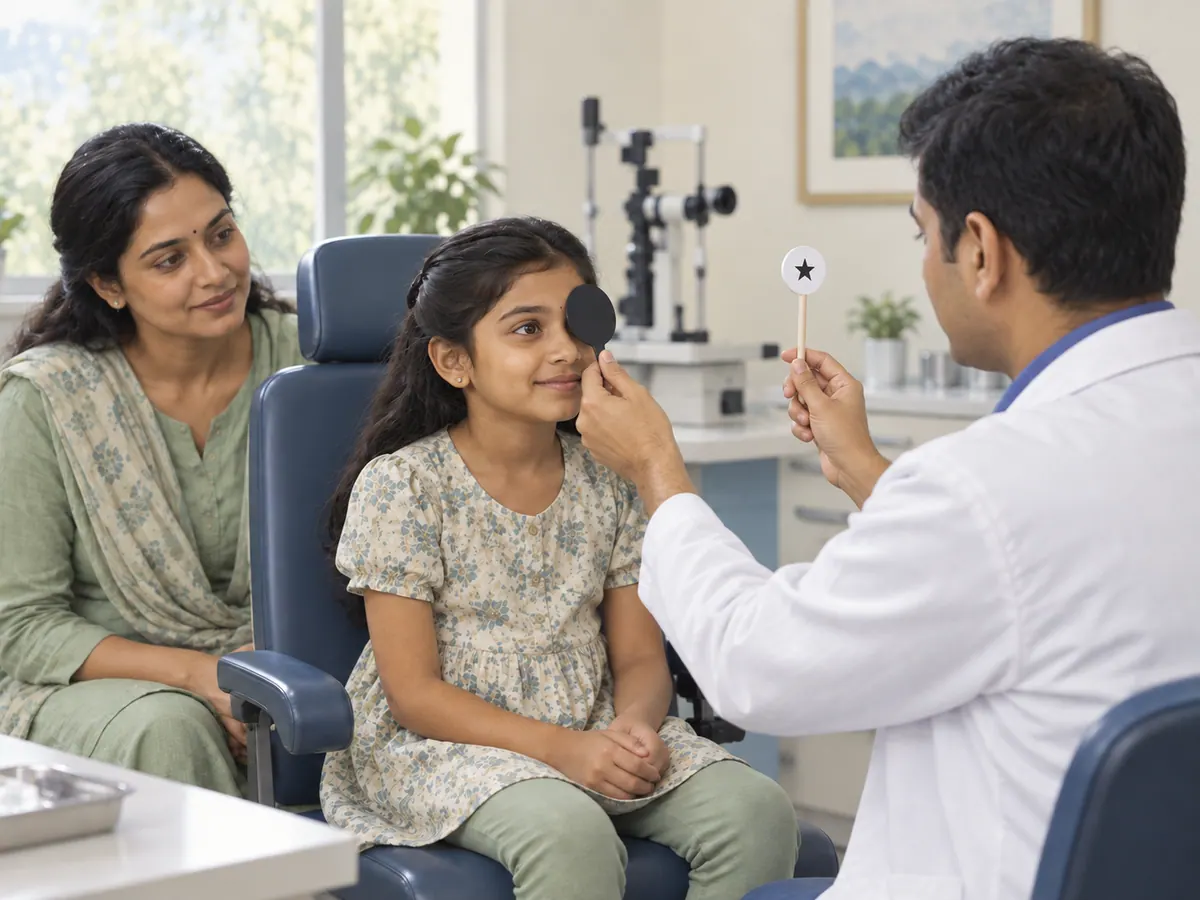
Squint care needs more than deciding whether an eye turns. The pattern, vision in each eye, glasses prescription, binocular function, symptoms and health of the eyes all influence treatment.
Consultations with a squint specialist are available by prior appointment. Contact us to confirm the centre and timing.
Distance, near and gaze-position measurements support an individual diagnosis and surgical plan.
Squint surgery is coordinated at the Nallasopara East surgical centre after clinical and anaesthesia clearance.
Glasses, amblyopia care and alignment monitoring continue when required before and after surgery.
Strabismus, commonly called squint, occurs when both eyes do not point at the same target at the same time. The deviation may be constant or intermittent and may turn inward, outward, upward or downward.
In childhood, the brain may suppress the image from the deviating eye to avoid double vision, increasing the risk of amblyopia and reduced depth perception. Adults with a new deviation are more likely to experience double vision because their visual system has already learned to combine two aligned images.
A longstanding childhood squint and a new-onset deviation require different thinking. Sudden double vision or a new turn—especially with neurological symptoms, trauma, pain or a pupil abnormality—needs prompt medical assessment.
The surgeon also considers when the turn started, whether it is constant, how well it is controlled, whether the angle changes with gaze, and whether glasses or another disease contribute.
One eye turns toward the nose constantly or intermittently. Some childhood esotropia is linked to farsighted focusing effort and improves substantially with the correct glasses; other forms require different treatment.
Cycloplegic refraction, alignment measurements and amblyopia testing help distinguish accommodative from non-accommodative patterns and guide whether glasses, bifocals, amblyopia care or surgery is appropriate.
One eye drifts outward, often first noticed when the person is tired, unwell, daydreaming or in bright sunlight. Frequency and control can change over time.
Observation may be suitable when control is good. Treatment can include glasses, selected orthoptic measures or surgery when the deviation is frequent, poorly controlled, symptomatic or affecting binocular function.
One eye sits higher or lower than the other. A person may tilt or turn the head to reduce double vision and obtain a more comfortable area of binocular vision.
The cause may involve an eye muscle, its nerve supply, thyroid eye disease, injury or another pattern. Prisms or surgery can help selected cases after the deviation is carefully mapped.
A large constant deviation in infancy can interfere with binocular visual development. Brief intermittent crossing can occur in very young babies, but a persistent turn or an abnormal red reflex needs prompt examination.
Vision, refractive error and eye health are assessed first. Amblyopia treatment and glasses may be required, while eye-muscle surgery is often considered at a developmentally appropriate time.
A nerve palsy, thyroid eye disease, injury, orbital disease or tight eye muscle can prevent normal movement and produce double vision. New adult-onset misalignment must not be assumed to be a childhood squint.
Assessment may require medical history, pupil and neurological examination, blood tests or imaging. Temporary prism, observation or occlusion can be used while the cause and stability are established before surgery.
A deviation may remain after prior treatment or the eye may later turn in the opposite direction. Growth, changing vision, scar tissue and the original diagnosis can all influence alignment over time.
Old operation notes and photographs are valuable. Re-operation can be considered, but planning accounts for previous muscle surgery, current measurements and the risk of double vision.
Family photographs and short videos can help document an intermittent deviation that is not present during the visit. Note whether the turn appears when tired, looking far away, reading or in bright light.
Arrange a squint assessmentMeasurements can vary with attention, fatigue, glasses and viewing distance. More than one visit may be needed before surgery when the angle is inconsistent or the cause has not stabilised.
Each eye is assessed separately using age-appropriate methods. Unequal vision may indicate amblyopia, cataract, retinal disease or another reason the eye has drifted.
Cover–uncover and alternate-cover tests reveal manifest and latent deviations. Prisms quantify the angle at distance, near and different gaze positions for treatment and surgical planning.
The clinician checks how each eye moves, whether movement is restricted and whether a head turn or tilt compensates for the deviation.
Dilating drops relax a child’s focusing system so farsightedness, myopia, astigmatism and unequal prescriptions are accurately measured before surgery is considered.
Age-appropriate tests assess whether the eyes combine images and appreciate depth. Results help explain symptoms and set realistic functional goals.
Pupils, lids, the front of the eye, lens, optic nerve and retina are examined as indicated. New or atypical squint may require systemic evaluation or imaging rather than immediate eye-muscle treatment.
Treatment is sequenced around the cause. Glasses and amblyopia may need attention before surgical measurements, while new adult double vision may require investigation or a period of stability first.
The full appropriate prescription may straighten accommodative esotropia and provides a clear image for both eyes. Bifocals or prisms are useful only for selected patterns.
Patching or atropine treats reduced visual development; it does not directly reposition the eye muscles. Vision is commonly improved or balanced before final surgical measurements.
Prisms can reduce double vision for some small or stable deviations. Exercises have a defined role in selected convergence problems but are not a universal cure for every squint.
The surgeon weakens, strengthens or repositions selected extraocular muscles to change alignment. The plan may involve one or both eyes even when only one eye appears to turn.
The surgeon reaches the extraocular muscles through the conjunctiva, then weakens, strengthens or repositions selected muscles. Surgery may be advised on one or both eyes even if only one appears to turn. Most cases are planned as day-care procedures, subject to individual health and anaesthesia needs.
Repeated measurements confirm the pattern and stability. The surgeon discusses whether the main goal is binocular function, relief from double vision, head-posture improvement, alignment or a combination.
Medical history, medicines, allergies and fasting instructions are reviewed. Children usually require general anaesthesia; the anaesthesia plan for adults depends on health and the procedure.
Through the conjunctiva, selected muscles are recessed, resected, plicated or otherwise repositioned. The eyeball is not removed and there is normally no skin incision.
Redness, grittiness and discomfort with eye movement are expected initially. Drops, activity restrictions and review dates are individualised, and alignment is assessed as swelling settles.
Eye alignment, binocular cooperation in suitable patients, double vision, visual confusion, abnormal head posture and the social or functional impact of misalignment.
Perfect alignment cannot be guaranteed. Residual or recurrent squint, temporary or persistent double vision, scarring, infection, anaesthesia complications and the rare risk of serious eye injury are discussed during consent.
Glasses, amblyopia treatment, prism or later surgery may still be required. Redness can remain for weeks even when discomfort improves within days.
Adults may have residual childhood squint or a deviation caused by nerve palsy, thyroid eye disease, trauma, stroke-related disease or age-related orbital change. New adult squint commonly causes double vision and should be investigated before treatment.
Prism, selected exercises or surgery may reduce symptoms and improve alignment. Eye-muscle surgery can be reconstructive because misalignment affects visual function, head posture, confidence and quality of life—not appearance alone.
Consultations and measurements may be handled differently from surgery. Pre-authorisation can require diagnosis, photographs, prism measurements, symptom documentation, previous treatment and the proposed muscle procedure.
JEWCC can help prepare available clinical and surgical documents, but eligibility, package limits, co-payments and final approval remain with the insurer or TPA.
Call before travelling so the team can confirm the consultant’s next clinic location and time. After the surgical plan is finalised, JEWCC coordinates pre-anaesthesia preparation and the operative date at its Nallasopara East surgical centre.
Jaypuriya Eye Care Centre
The consultant squint surgeon sees patients by prior appointment. Call or message JEWCC with the patient’s age, main concern and preferred centre so the team can confirm the next consultation location and timing.
No. Some squints improve with the full glasses prescription, amblyopia treatment, prisms or observation. Surgery is considered when the type, frequency, measurements, symptoms or functional goals make eye-muscle repositioning appropriate.
Yes. Squint surgery is available through JEWCC and is coordinated at the Nallasopara East surgical centre after consultation, measurements and pre-anaesthesia assessment. The surgeon confirms the operative plan, date and suitability.
Squint surgery changes eye alignment; it does not directly cure amblyopia or replace glasses. Amblyopia is commonly treated before and sometimes after surgery so each eye has the best possible visual input.
Yes. Adults are not too old solely because of age. Treatment can reduce double vision, improve abnormal head posture, support binocular function and improve alignment and quality of life. A new adult squint first requires evaluation for an underlying cause.
They can. Most patients obtain meaningful alignment improvement, but under-correction, over-correction or later change is possible. Glasses, prisms or additional surgery may sometimes be required. The surgeon discusses goals and uncertainty for the individual pattern.
Many policies treat medically indicated eye-muscle surgery as reconstructive rather than cosmetic, but coverage varies. Pre-authorisation may require photographs, alignment measurements, diagnosis records and the proposed procedure. The insurer or TPA makes the final decision.