Types and related conditions
The same pressure reading can mean different things in different eyes.
Classifying the drainage angle and identifying secondary causes affects treatment. “Glaucoma suspect” and ocular hypertension also require thoughtful monitoring, but they do not automatically mean permanent damage is present.
01Common and usually silent
Primary open-angle glaucoma
The drainage angle is physically open, but fluid leaves the eye less efficiently. Optic-nerve damage generally develops slowly, so useful side vision can be lost before a person notices a problem.
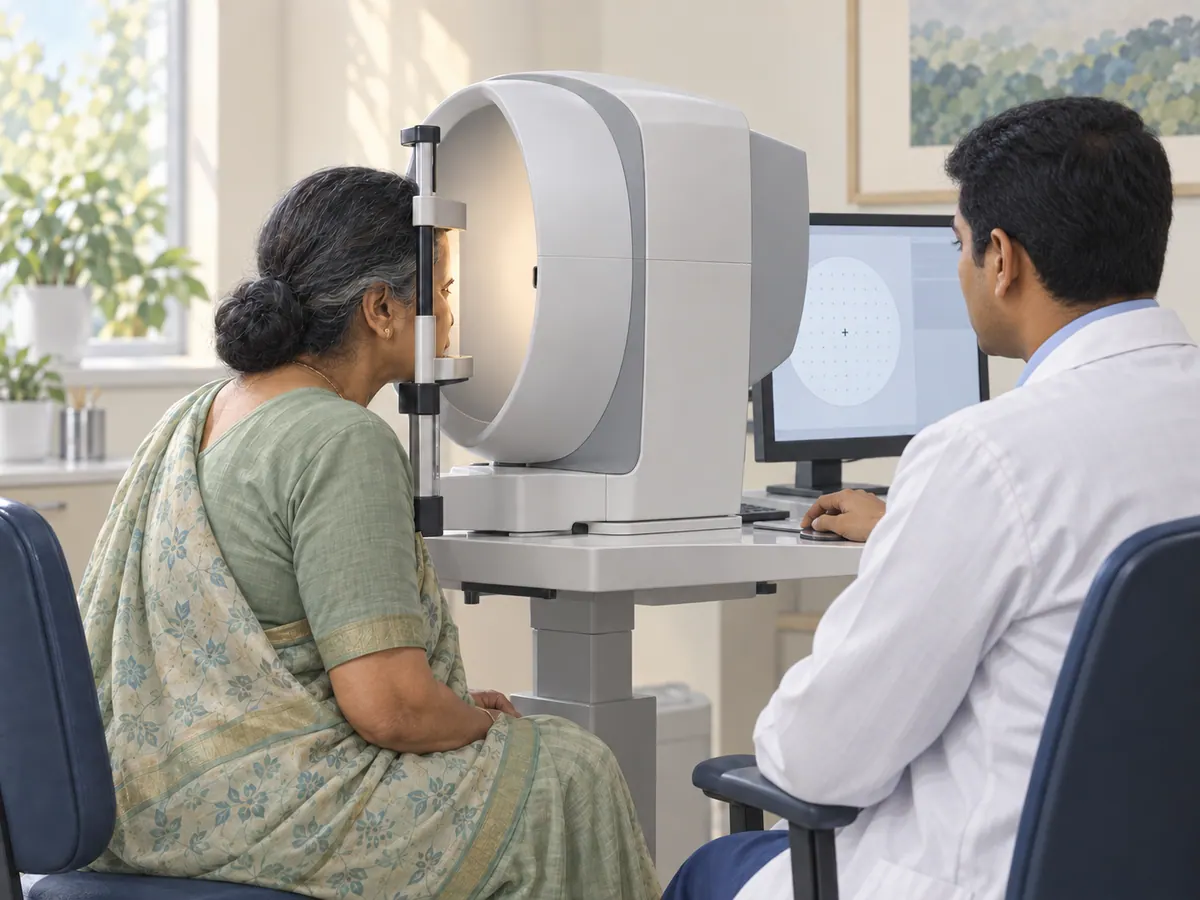
How care may be plannedDiagnosis and follow-up combine optic-nerve examination, pressure measurements, OCT and visual-field testing. Treatment is adjusted to an individual target pressure and evidence of progression.
02Narrow or blocked drainage angle
Angle-closure glaucoma
The iris obstructs the eye’s drainage angle. Closure may develop gradually without obvious symptoms, or happen suddenly with severe pain, redness, blurred vision, coloured haloes, headache, nausea or vomiting.
How care may be plannedAn acute attack is an emergency. Medicines and laser peripheral iridotomy are commonly used to open an alternative fluid pathway; the other eye may also require preventive assessment or treatment.
03Damage at statistically normal pressure
Normal-tension glaucoma
Characteristic optic-nerve and visual-field damage can occur even when measured eye pressure falls within the usual population range. A single “normal” pressure reading therefore cannot rule out glaucoma.
How care may be plannedThe diagnosis requires careful structural and functional assessment and exclusion of other causes of optic-nerve damage. Lowering pressure can still slow progression.
04Raised pressure without proven damage
Ocular hypertension
Some people have higher-than-average eye pressure but no detectable optic-nerve injury or visual-field loss. This is not the same as glaucoma, although it can increase future risk.
How care may be plannedCorneal thickness, pressure level, age, optic-nerve appearance, family history and other risks help decide whether observation or pressure-lowering treatment is appropriate.
05Another condition contributes
Secondary glaucoma
Pseudoexfoliation material, pigment dispersion, inflammation, eye injury, abnormal new vessels, certain medicines or previous eye surgery can interfere with drainage and damage the optic nerve.
How care may be plannedManagement addresses the cause where possible while lowering eye pressure. The treatment plan can differ substantially from routine primary open-angle glaucoma care.
06Congenital and paediatric disease
Childhood glaucoma
Rare drainage-development problems can affect babies and children. Warning signs may include excessive tearing, light sensitivity, cloudy corneas or an eye that appears enlarged.
How care may be plannedPrompt specialist evaluation is important because early pressure control supports visual development. Surgery is often central to congenital glaucoma treatment.